The common idea of transformation is often associated with the evolution of an organization through the adoption of new technologies, innovations or the creation of products and services that promise superior growth.
In contrast, repairing the problems that hinder, generate friction or reduce competitiveness is often perceived as an act of "stopping to solve".
Evolve or stop, concepts that seem contradictory and force a choice.
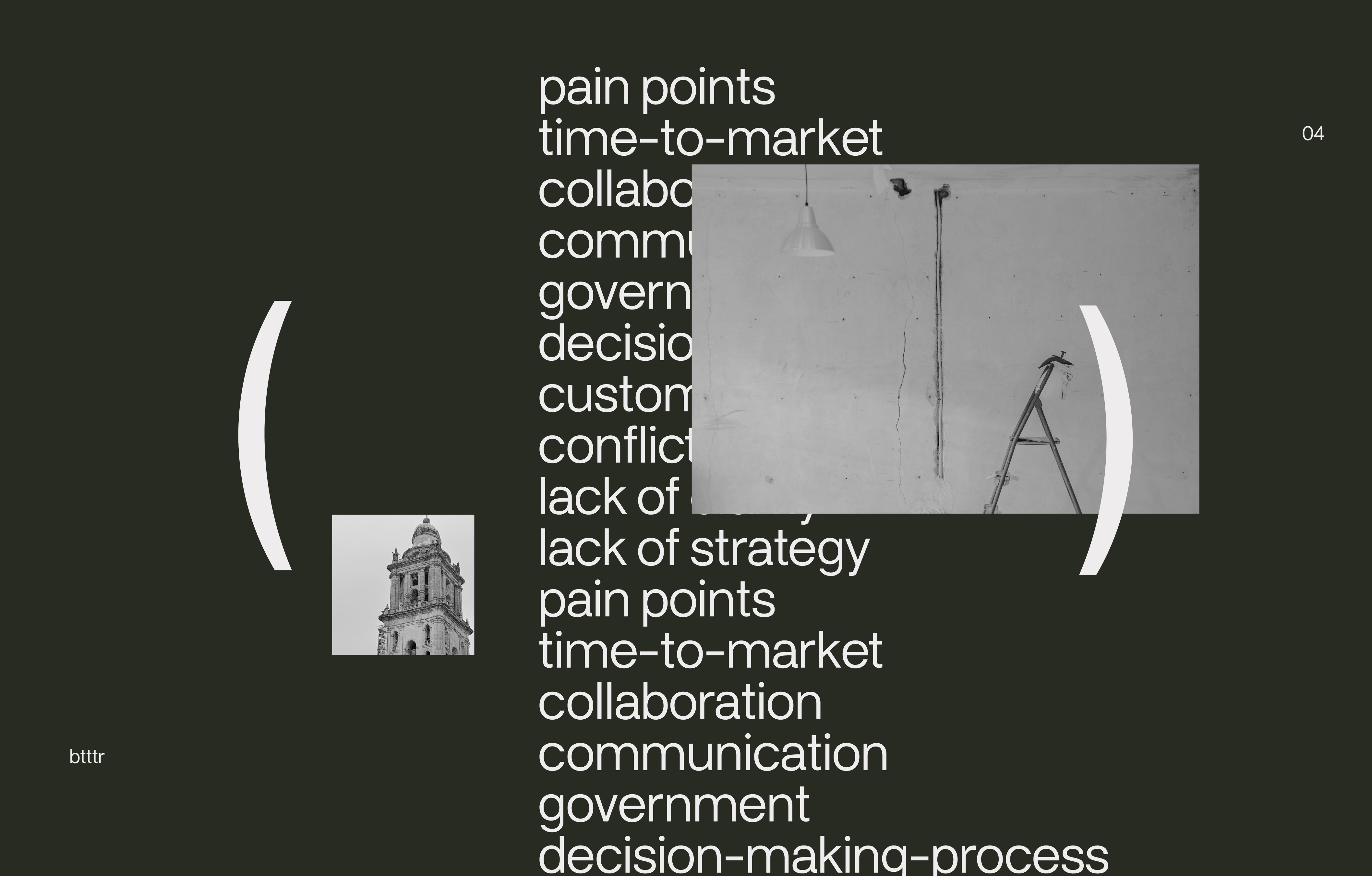
When we talk about the pains of an organization, we refer to significant pains: tensions that have accumulated over time, sometimes due to a larger scale or size, or as a result of previous change initiatives that were not effectively implemented.
These problems manifest in various forms, and often have their origin in "how the organization delivers value" to its customers or in "how it is structured" internally to achieve it.
Some examples are:
Poor service or channels with high friction and frustration that push customers to seek alternatives.
Design or technology teams that delay their delivery times preventing them from achieving objectives and providing quality products and services to customers.
Lack of alignment of the organization's priorities and resources generating internal tensions and disappointing results.
The crucial thing is that all these problems compromise the organization's competitive capacity, slow it down or make it vulnerable to competition or the environment.
There are multiple reasons why these problems persist:
Lack of capabilities or resources, or being too immersed in daily operations.
Lack of a clear strategy that fosters such alignment and clarity.
Failed attempts at resolution that have only increased tension and frustration.
Ignorance about how to address them.
Evading, ignoring or denying the problem and the associated risk until it is too big.
Staying in the pain, for fear that change will stop them.
It is common to observe the implementation of initiatives or investments that, instead of solving the root cause, camouflage it. What is known as antipatterns.
Energy and resources are invested in reaching new objectives that are often not achieved precisely because the underlying problems act as a burden.
For example, hardly incorporating Artificial Intelligence capabilities to increase sales will help if the digital channels of the organization where customers interact are confusing, complicated and invite them to seek alternatives.
A competitor whose channels offer simplicity, speed and efficiency will be able to quickly attract customers from those companies that generate friction, slowness and discomfort.
By the way, this case, although it may seem obsolete for the technology sector, remains a pending issue for much of the business fabric, which hypnotized by new trends, forgets how user experience plays a vital role in generating conversion, credibility and customer loyalty.
Returning to the subject. Resolving pain points is not optional.
It may not seem important in the short term, but it is vital in the medium and long term where circumstances will inevitably arise that will make the organization much less prepared to solve them.
A new competitor or a change in strategy from an existing one, an economic crisis, times of extreme uncertainty like those we are living in, a new regulation, can easily test and damage an organization that has chosen not to heal how it delivers value, how it serves customers, which is slow to make decisions or execute its strategy. Reactivity and tension will surface and it will be less in control of its destiny.
On the other hand, an organization capable of resolving what weakens it becomes a stronger, competitive and productive entity, but above all, a better-established organization in the market.
Repairing is transforming. Repairing is building quality in every process, every touchpoint, in every internal or external interaction.
Repairing is a necessary strategic movement.
For all this, we believe that in this or the next annual or quarterly strategic planning cycle it may be the perfect opportunity for introspection, focusing a bit on what has been painful for a long time. The starting point begins with a simple question.
What pains in our organization become an opportunity when resolved?
—-
Author's note: These publications are the result of our own experience, life moments and opinions. We share what we know to contribute and understand that NOT everything we have will work for everyone. Feel free to make it your own if it serves you or ignore it if it does not.